



A conflict thousands of miles from New Jersey can affect what it costs to heat a home in Cherry Hill.
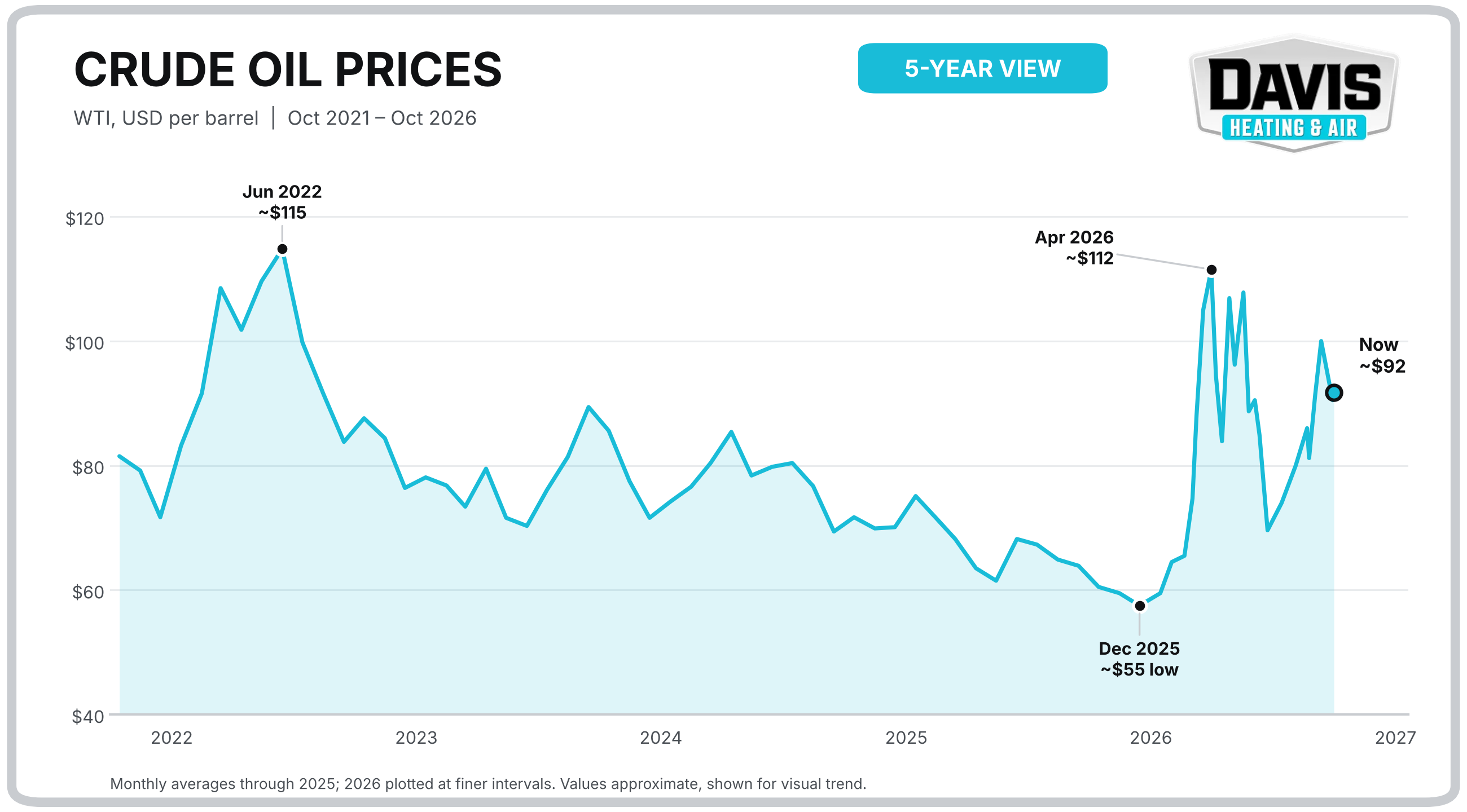
That may sound strange. Your heating oil could come from a local delivery company, your boiler is sitting in your basement, and nothing about your house has changed.
But heating oil is a petroleum product. Its price is connected to crude oil, refining capacity, global supplies, shipping, regional inventories, and demand.
That connection is especially relevant heading into the 2026–2027 heating season.
Recent conflict in the Middle East has disrupted global oil and fuel supplies. On September 30, Brent crude settled at $103.50 per barrel after gaining roughly 14% during September. On October 1, prices rose again after China suspended most fuel exports, adding another potential constraint to already-tight global fuel markets.
For South Jersey homeowners with oil boilers and furnaces, the important question isn’t what tomorrow’s barrel of crude will cost.
It’s this:
If heating oil becomes more expensive, what can you actually do about it?
There may be more options than replacing your oil heating system.
Book OnlineWhy Can Overseas Conflict Affect New Jersey Heating Oil Prices?
Heating oil is closely related to diesel fuel. Both are petroleum distillates produced primarily from crude oil.
That means the price delivered to a New Jersey home isn’t determined only by local supply and demand.
According to the U.S. Energy Information Administration (EIA), distillate prices are influenced by crude-oil prices, refining margins, distribution costs, taxes, and the supply of finished petroleum products.
A disruption overseas can therefore travel through the market something like this:
Conflict or supply disruption → less crude or refined fuel available → tighter global supply → higher wholesale costs → potentially higher heating-oil prices in New Jersey.
The connection isn’t always immediate or one-to-one.
A 10% increase in crude oil does not automatically mean your next heating-oil delivery will cost exactly 10% more. Refinery output, inventories, transportation, local competition, weather, and other factors also influence the final price.
But global events can absolutely affect a South Jersey heating bill.
Why Are New Jersey Heating Oil Prices Especially Exposed?
Heating oil occupies an unusual place in the American energy market.
Nationally, relatively few homes depend on it. But its use is heavily concentrated in the Northeast. EIA data show that more than 80% of U.S. homes primarily heated with oil are located in the Northeast.
New Jersey is part of that regional heating-oil market.
That matters because winter heating demand arrives at the same time that diesel and other distillate fuels are competing for supply.
The Northeast can therefore be affected by a combination of:
- Global crude-oil prices
- Global diesel and distillate shortages
- Refinery production
- Imports and exports
- Northeast fuel inventories
- Transportation and delivery costs
- Winter weather
- Local heating demand
In 2026, several of those factors have become important at the same time.
What Is Happening With Oil and Fuel Markets in 2026?
The current situation provides a good example of how distant events can work their way toward household energy costs.
Middle East conflict has disrupted oil supplies and shipping during 2026. Brent crude moved back above $100 per barrel in September as attacks on shipping increased concerns about supply disruptions.
But crude oil is only part of the story.
The EIA reported in September that global supplies of distillate fuels—including diesel—were tight because of reduced refining activity in Russia, China, and the Middle East. U.S. distillate inventories were 13% below their previous five-year seasonal average in the week ending September 11.
Then, on October 1, Reuters reported that Chinese refiners had suspended most fuel exports for October as China sought to preserve its own inventories amid global supply disruptions.
These developments don’t tell us exactly what a gallon of heating oil will cost in Cherry Hill this winter.
They do tell us why homeowners shouldn’t assume a local heating-oil price is determined entirely by what happens locally.
New Jersey Heating Oil Prices Can Move Quickly
We have already seen an unusually clear example this year.
EIA’s weekly New Jersey wholesale data show No. 2 heating oil at about $2.20 per gallon in late December 2025. By March 23, 2026, the wholesale price had risen to about $4.70 per gallon. Those are wholesale/resale figures rather than the retail price a homeowner would pay, but they illustrate how rapidly the underlying market can change.
That doesn’t mean another increase of that size is coming.
Oil prices can fall quickly, too.
For example, crude prices fell sharply on September 25 as markets reacted to the possibility of progress in U.S.-Iran negotiations.
That volatility is actually the point.
A New Jersey homeowner cannot control the Strait of Hormuz, refinery production, international shipping, or global oil markets.
But you can influence how much fuel your house needs.
And that’s where the HVAC conversation becomes more useful.
If Heating Oil Prices Rise, Start With the Boiler You Already Own
When oil becomes expensive, it’s tempting to immediately think:
“I need to get rid of my oil boiler.”
Maybe eventually.
But don’t start there.
Davis Heating & Air is a Fix-It-First company. That means we’ll use the tools in our arsenal to diagnose, maintain, and repair your existing heating system and do everything reasonably possible to get it operating reliably before recommending replacement.
A working oil boiler does not suddenly become bad equipment because the commodity it burns became more expensive.
First, find out how well the system is operating.
Boiler Maintenance Can Matter More When Every Gallon Costs More
If you’re going to buy heating oil, you want the heating system using that fuel to be operating properly.
A boiler that hasn’t been maintained may have combustion, control, circulation, or other issues that affect how well the complete system performs.
Professional boiler maintenance in Cherry Hill, NJ can include checking the burner and combustion, controls, system pressure, circulation, safety components, and other system-specific items.
Maintenance cannot control the price of oil, but it can help make sure you’re not ignoring correctable problems in the equipment you’re paying to operate.
Don’t Confuse a Heating-System Problem With an Energy-Price Problem
This distinction is important.
Suppose your heating bill suddenly increases.
It is easy to conclude:
“My old boiler is costing me a fortune.”
But two completely different things could be happening.
The fuel got more expensive.
Your boiler may be consuming roughly the same amount of oil, but each gallon costs more.
The house is using more fuel.
The weather may be colder. The boiler may need service. The house may be losing more heat than expected. A control issue could be affecting operation.
Or both things may be happening simultaneously.
Before spending thousands of dollars replacing heating equipment, Davis can help determine whether the equipment itself actually has a problem.
That’s the Fix-It-First difference: diagnose first, replace when replacement is actually justified.
Your House May Be Wasting Heat Before the Boiler Is Wasting Fuel
Heating costs aren’t determined by the boiler alone.
Think of your home as a container for heat.
If heat is escaping through an under-insulated attic, major air leaks, poorly performing ductwork where applicable, or other weaknesses in the building envelope, the heating system has to continually replace it.
That means an oil-saving strategy shouldn’t automatically begin in the boiler room.
Sometimes reducing the amount of heat the house requires can reduce fuel consumption without changing the heating equipment at all.
This is particularly worth considering in older South Jersey homes, where the boiler may have been installed long before today’s insulation and air-sealing practices became common.
Could a Heat Pump Reduce Your Exposure to Heating Oil Prices?
Potentially, yes.
And you don’t necessarily have to remove the oil boiler to do it.
This is one of the more interesting options for South Jersey homeowners.
A heat pump can provide heating during mild and moderately cold weather while the existing oil boiler remains available for colder conditions.
Instead of burning oil every time the house needs heat from October through April, the heat pump can carry part of the heating season.
That gives the homeowner access to two energy sources:
electricity and heating oil.
If the boiler is still reliable, keeping it can preserve cold-weather heating capacity while reducing the number of annual hours it needs to run.
Replacing Your AC Can Be an Opportunity
This option becomes especially interesting if you already need a new air conditioner.
Imagine a home with:
Oil boiler → winter heat
Central AC → summer cooling
When the AC reaches the end of its life, you could replace it with another cooling-only air conditioner.
Or Davis can evaluate whether replacing it with a heat pump makes sense.
The heat pump now provides:
Summer cooling + heating during part of the winter
while the oil boiler remains available when needed.
Instead of throwing away a functioning boiler solely because oil prices are volatile, you’ve changed how often you need to use it.
When Should a Heat Pump Hand Heating Back to the Oil Boiler?
A hybrid oil-boiler and heat-pump system can be designed around a switchover temperature.
Above that outdoor temperature, the heat pump handles the heating.
Below it, the boiler takes over.
That temperature is not universal.
It depends on factors such as:
- The home’s heating load
- The heat pump’s low-temperature performance
- Boiler condition and efficiency
- Electricity prices
- Heating-oil prices
- System design
- Homeowner comfort preferences
Importantly, the switchover temperature can be an economic decision as well as an equipment decision.
If oil becomes significantly more expensive relative to electricity, the economics of operating the heat pump at colder temperatures can change.
If the relationship moves the other way, the preferred balance point can change again.
That is a much more flexible strategy than assuming one heating source must always do everything.
Should You Replace an Oil Boiler Because Heating Oil Prices Are High?
Not automatically.
Oil prices are volatile. Heating equipment is a long-term investment.
Replacing a serviceable boiler solely because of a temporary spike in fuel prices can mean making a 15- or 20-year equipment decision in response to a market condition that could change much sooner.
Instead, evaluate the bigger picture.
How old is the boiler?
How reliable is it?
How much oil does the home actually consume?
Does it need repair or maintenance?
How much heat is the house losing?
Do you already need to replace your air conditioner?
Could a heat pump reduce oil use without eliminating the boiler?
Would complete replacement provide enough long-term benefit to justify the investment?
Those answers tell you much more than today’s price per gallon.
When Oil Boiler Replacement Does Make Sense
Fix-It-First does not mean keeping a boiler forever.
Every heating system eventually reaches the end of its practical service life.
Replacement may make sense when an oil boiler develops major problems, requires increasingly frequent repairs, becomes unreliable, has serious combustion or venting issues, or no longer fits the homeowner’s long-term heating plans.
Davis Heating & Air provides boiler installation and boiler replacement in Cherry Hill, NJ and the surrounding South Jersey area when replacement is the appropriate next step.
We can also evaluate heat-pump installation and hybrid heating options for homeowners interested in reducing their dependence on oil.
But the process should begin with understanding what you already have.
Oil Boiler Repair in Cherry Hill, NJ
If your oil boiler stops working correctly, a high oil price does not automatically make replacement the answer.
Davis provides oil boiler repair in Cherry Hill, NJ and the surrounding areas.
As a Fix-It-First company, our goal is to find the actual problem and use the tools available to us to get your existing heating system operating safely and reliably whenever a reasonable repair can accomplish that.
If repair makes sense, we’ll explain the repair.
If replacement genuinely makes more sense, we’ll explain why.
The homeowner should understand both before making the decision.
Overseas Conflict Can Reach Your Boiler Room—But It Doesn’t Make Your Decisions for You
The connection between an overseas conflict and a South Jersey basement is surprisingly direct.
Heating oil comes from a global petroleum market.
Wars can disrupt production, refining, and shipping. Inventories can tighten. Crude and distillate prices can rise. Eventually, those changes can affect what a New Jersey homeowner pays for a delivery.
What happens next is still up to the homeowner.
You may be able to maintain and repair the boiler you already have.
You may find opportunities to reduce the home’s heating load.
You may decide to add a heat pump and use less oil without abandoning the boiler.
Or, when the existing equipment truly reaches the end of its useful life, you may decide that replacement is the right long-term move.
Davis Heating & Air can help you work through those options.
We provide oil boiler maintenance, boiler repair, boiler installation and replacement, and heat pump maintenance, repair, installation and replacement in Cherry Hill, NJ and the surrounding South Jersey area.
And because Davis is a Fix-It-First company, we’re going to use the tools in our arsenal to get the heating system you already own running safely and reliably before recommending that you replace it.
Global oil prices can change quickly. Your heating-system decisions should be made more carefully.
Call (856) 429-7979
 All Service Areas