


If your South Jersey home already has a reliable oil boiler, installing a heat pump does not necessarily mean the boiler has to go.
In fact, for some homes in Cherry Hill, NJ and the surrounding area, the better approach may be to keep the boiler, add a heat pump, and allow the two systems to divide the heating season between them.
The heat pump can handle much of the mild and moderately cold weather. When temperatures fall far enough that the boiler becomes the better option, the heating system can switch over and let the boiler take control.
The result is not necessarily an oil system competing against an electric system. It can be a coordinated heating strategy in which each piece of equipment is used where it makes the most sense.
At Davis Heating & Air, this also fits our Fix-It-First philosophy. If you already own a boiler that can be repaired, maintained, and kept operating reliably, our first instinct is not to tell you to throw it away. We look at the equipment you already have, determine what can be saved, and help you decide whether a repair, a new heat pump, a replacement system, or a combination of the two makes the most sense for your home.
Book Your Free Estimate Now!Can a Heat Pump and an Oil Boiler Work Together?
Yes. A heat pump and oil boiler can be configured so that the heat pump provides most of the heating during milder outdoor temperatures while the boiler becomes the primary heat source during colder weather.
Think of it less like choosing between two heating systems and more like assigning each one a job.
During a relatively mild South Jersey winter day, a heat pump can move heat into the home efficiently without firing the oil boiler.
As temperatures fall, the heat pump continues to operate, but there eventually comes a point where the boiler may become the more practical source of heat for that particular home.
That transition is often called a switchover temperature or balance point.
How Does the Heat Pump-to-Boiler Switchover Work?
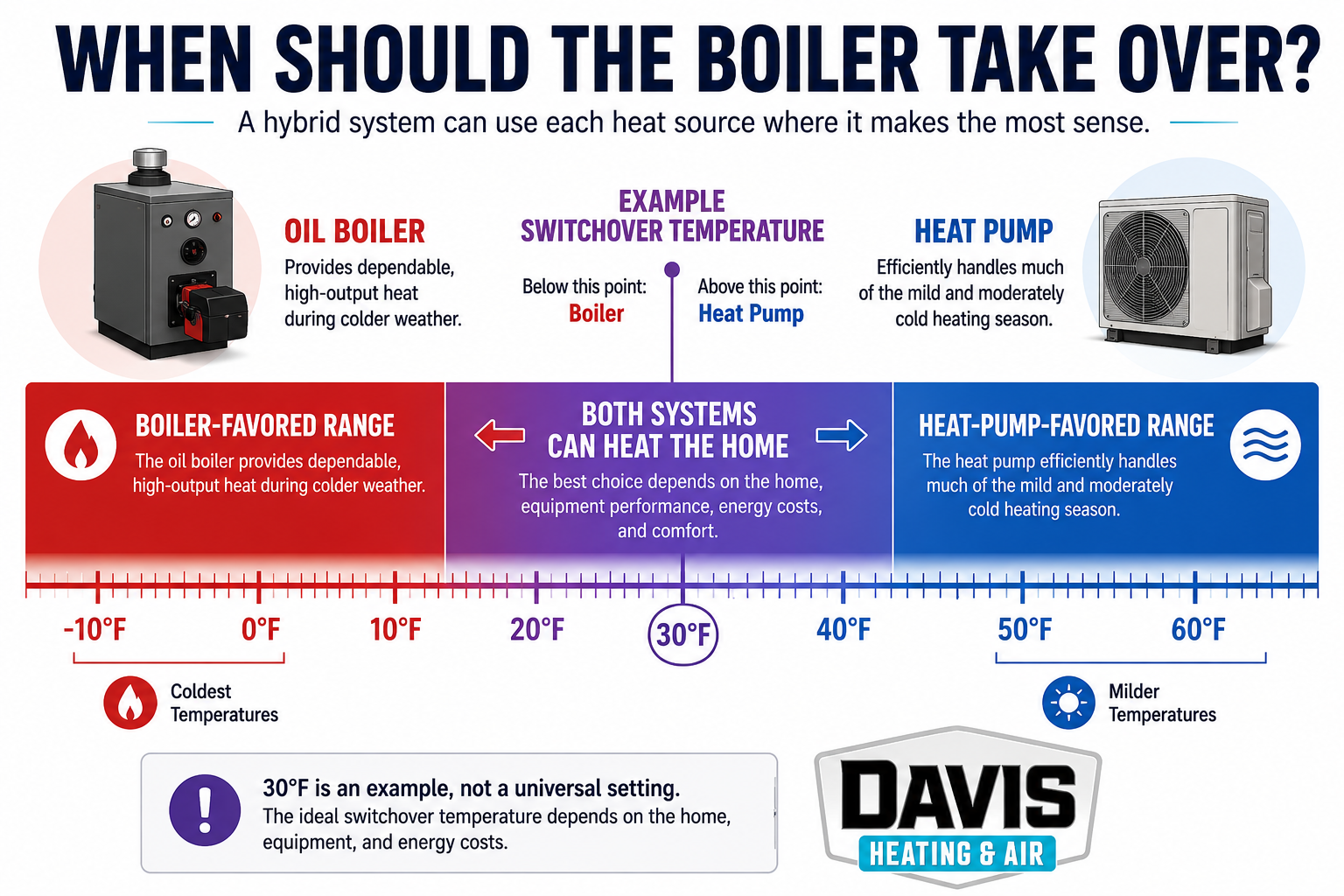
The easiest way to understand a hybrid boiler and heat pump system is to imagine a standard outdoor temperature scale.
The coldest temperatures are on the left. Warmer temperatures are on the right.
Our accompanying infographic divides that scale into three important areas:
Boiler-Favored Temperatures
At the cold end of the scale, the boiler becomes the preferred heat source.
An oil boiler can deliver a large amount of steady heat through radiators or hydronic baseboards, making it particularly useful when outdoor temperatures drop and the home’s heating demand increases.
This does not necessarily mean the heat pump has stopped working.
It means the controls have decided that, below a certain temperature, the boiler is the better tool for the job.
The Overlap Zone
The middle portion of the temperature scale is where things become more interesting.
In this range, both the heat pump and boiler may be capable of heating the home.
The question is no longer simply, “Which system works?”
The better question is:
Which system should we use right now?
That can depend on the heat pump’s low-temperature performance, the home’s heating load, the condition of the boiler, oil and electricity costs, and the homeowner’s comfort preferences.
Heat-Pump-Favored Temperatures
Move farther toward the warmer side of the scale and the heat pump generally becomes the natural choice.
South Jersey receives plenty of heating-season weather where it is chilly enough to need heat but nowhere near the coldest temperature the home will experience all winter.
Instead of firing an oil boiler every time the thermostat calls for heat on a 40°F or 45°F day, a properly designed heat pump may be able to handle the job.
Is 30°F the Temperature Where a Heat Pump Stops Working?
No.
This distinction is important.
Our infographic uses 30°F as an example switchover temperature, but 30°F should not be treated as a universal rule for every Cherry Hill home.
Modern heat pumps can continue producing heat well below freezing.
The switchover temperature is not necessarily the point where the heat pump suddenly becomes incapable of heating.
It is the point where the system has been configured to say:
Below this outdoor temperature, we would rather have the boiler handle the heating load.
For one home, that point might be around 30°F. For another, it could be lower or higher.
A properly designed hybrid system should determine the switchover point based on the actual house and the actual equipment rather than relying on a generic number.
Why This Heating Strategy Can Make Sense in South Jersey
One of the biggest mistakes in heating-system discussions is designing every decision around the coldest night of the year.
South Jersey winters do include freezing temperatures and occasional stretches of very cold weather.
But an entire heating season is not made up of those extreme conditions.
There are many fall, winter, and early spring days when outdoor temperatures are cool or moderately cold rather than bitterly cold.
Those conditions can be ideal for a heat pump.
That leads to a different way of thinking about home heating:
Why ask one system to handle every outdoor condition when two systems can divide the workload?
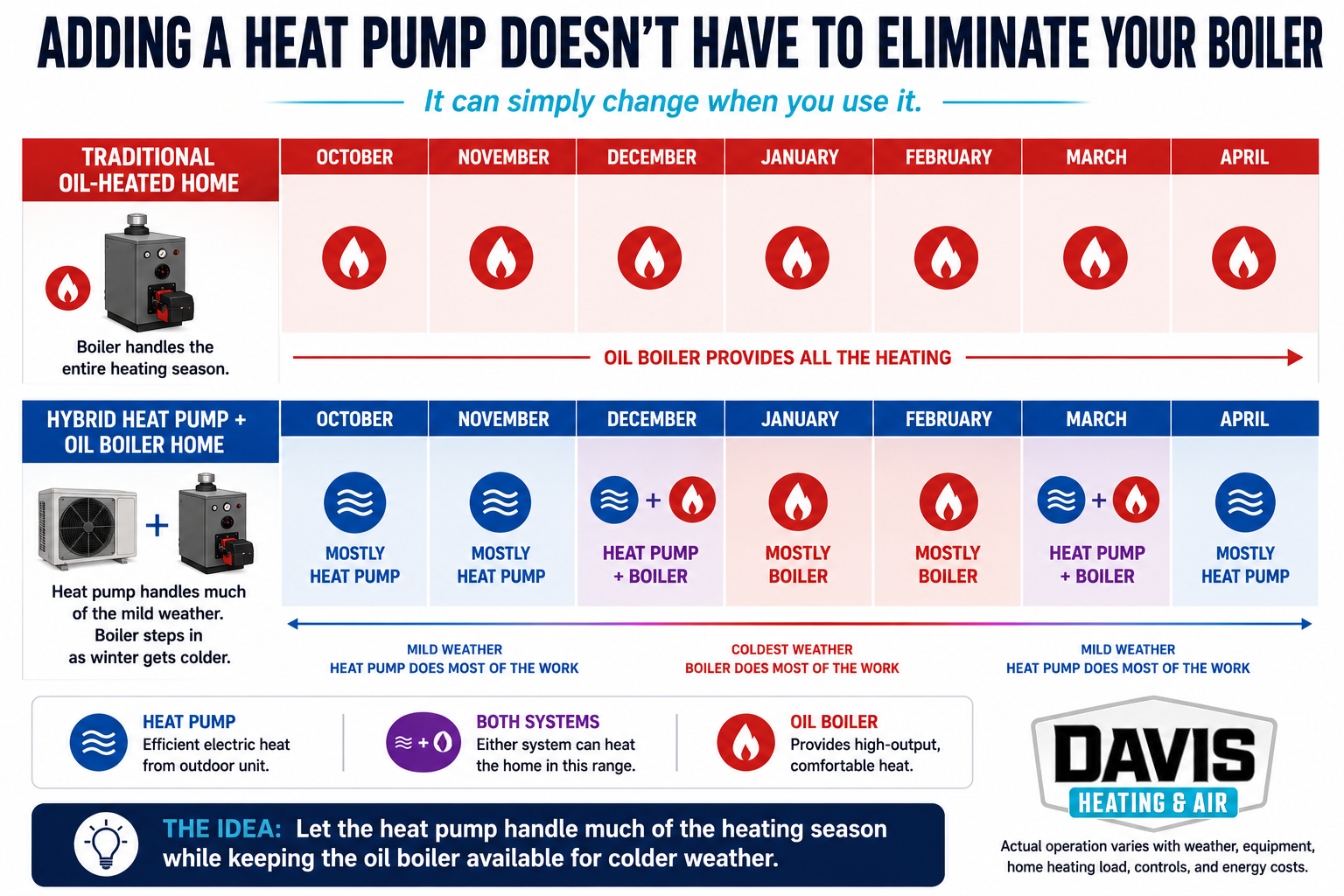
The heat pump can cover a large portion of the season.
The oil boiler remains available when the weather becomes colder and the heating load increases.
Instead of eliminating the boiler, you are changing its role.
Keeping the Boiler Can Be Part of the Upgrade
When homeowners hear about adding a heat pump, they sometimes assume that means removing the oil boiler.
It does not have to.
A functioning boiler may still offer valuable heating capacity, especially during the coldest parts of a New Jersey winter.
If that boiler is still in good condition, replacing it simply because another technology exists may not be the best use of your money.
This is where Davis Heating & Air’s Fix-It-First approach matters.
We believe an HVAC company should first determine whether your existing equipment can be restored to dependable operation.
If a boiler needs maintenance, a control repaired, a circulation problem corrected, or another service that can reasonably return it to reliable operation, we want to explore that option before pushing you toward replacement.
There are situations where replacement is absolutely appropriate.
But replacement should solve a problem. It should not be the default answer to every service call.
Replacing Your Air Conditioner? Consider a Heat Pump Instead
One of the most compelling opportunities for hybrid heating occurs when a homeowner already has an oil boiler but needs a new air conditioner.
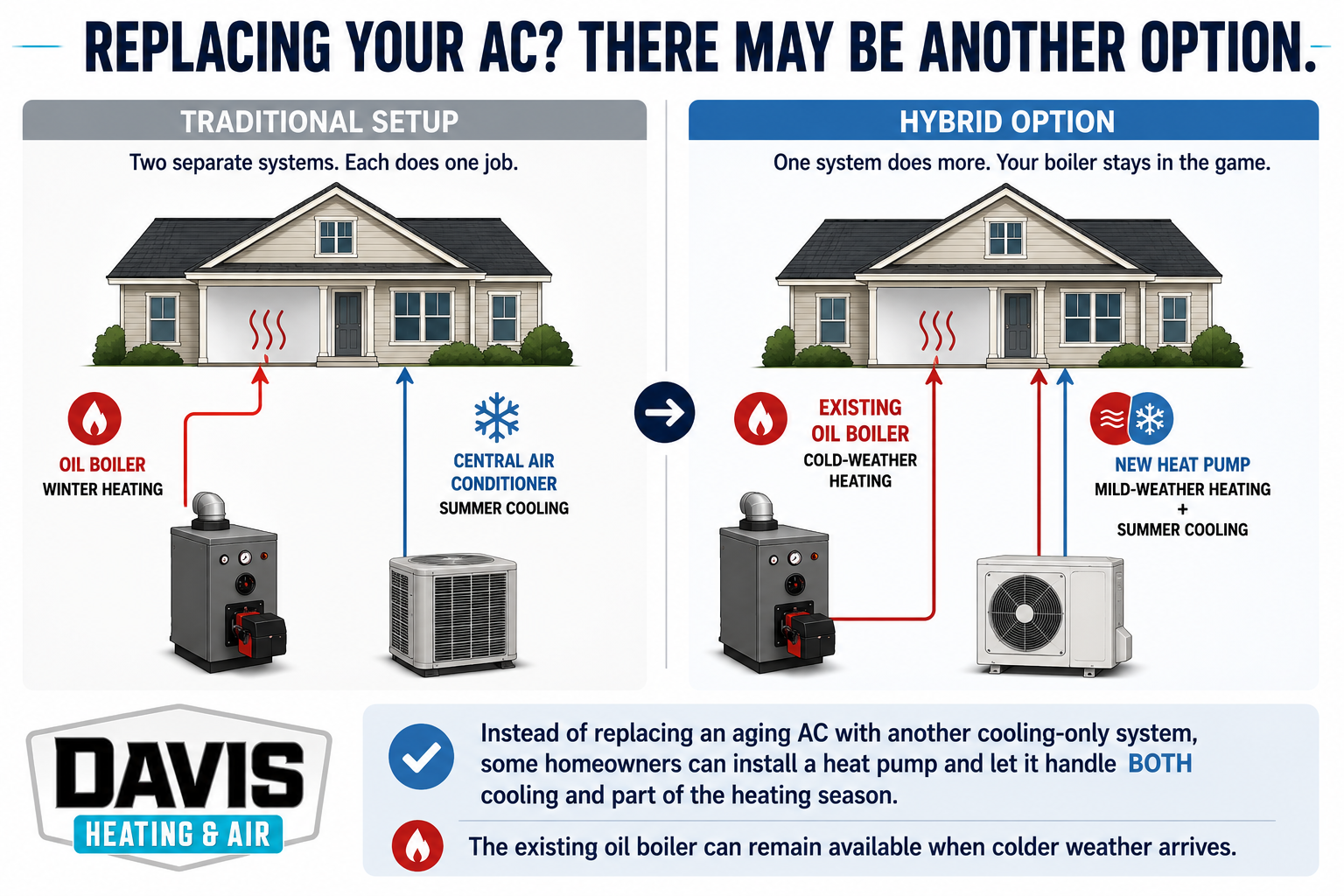
Consider the traditional setup:
- Oil boiler: heats the house in winter.
- Central air conditioner: cools the house in summer.
If the air conditioner reaches the end of its useful life, one option is simply installing another cooling-only system.
But another possibility is replacing that air conditioner with a heat pump.
Now the equipment that provides air conditioning during a Cherry Hill summer can also provide heat during much of the fall, winter, and spring.
The home’s heating arrangement can become:
- Heat pump: air conditioning plus mild- and moderate-weather heating.
- Oil boiler: cold-weather heating and backup.
For the right house, this can make much more sense than viewing the heat pump as an entirely separate heating-system purchase.
A Hybrid System Can Reduce How Often You Use Oil
For many homeowners, reducing oil consumption is appealing even if they are not ready to remove oil heat entirely.
A hybrid configuration can make that possible.
Instead of operating the boiler from the first cool morning in October until the last chilly evening in spring, the heat pump may handle much of that shoulder-season heating.
The boiler then spends more of the year waiting for the conditions where it provides the most value.
That may mean fewer annual burner hours and less dependence on heating oil without giving up the security of the existing boiler.
For some households, that middle ground is much more practical than immediately converting the entire home to another heating system.
How Does Davis Determine the Right Switchover Temperature?
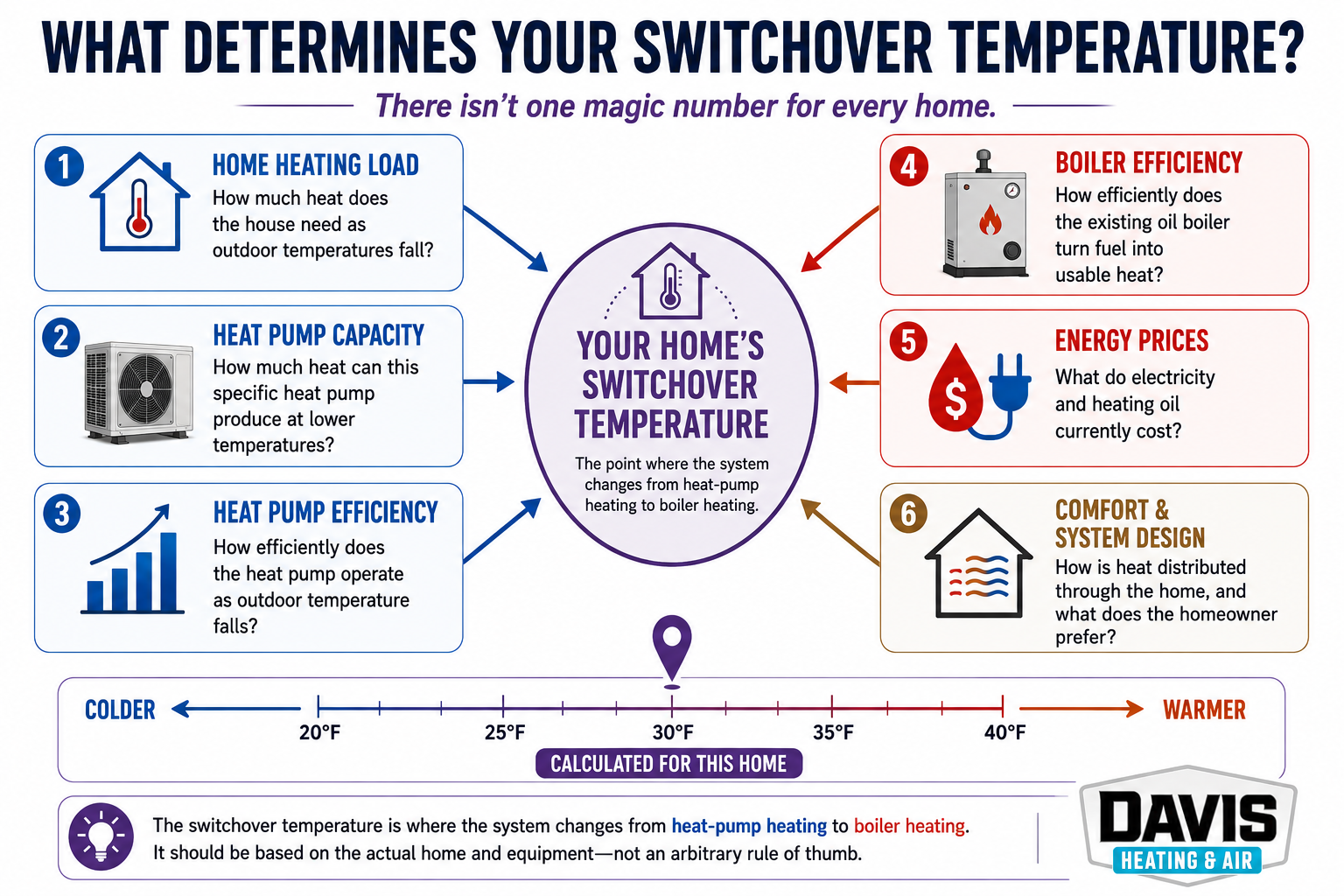
There is no single switchover temperature that is correct for every home.
A good system design looks at several factors together.
The Home’s Heating Load
As outdoor temperatures fall, the house loses heat faster.
A properly sized system needs to understand how much heat the building actually requires at different outdoor temperatures.
A well-insulated home may behave very differently from an older, draftier South Jersey house.
Heat Pump Performance
Not every heat pump produces the same amount of heat at low temperatures.
The specific equipment matters.
Rather than saying, “heat pumps work until 30°F,” we look at what the proposed system can actually deliver as the temperature drops.
Boiler Condition
A dependable boiler with useful service life remaining is a valuable asset in a hybrid system.
A severely deteriorated boiler that needs repeated major repairs changes the equation.
That is why the existing system should be inspected rather than automatically assumed to be either good or bad.
Oil and Electricity Costs
The temperature where one system becomes less expensive to operate than another can change depending on energy prices.
That economic balance point may be different from the temperature where the heat pump reaches its capacity limit.
Comfort Preferences
Some homeowners genuinely enjoy hydronic heat.
Radiators and baseboard systems deliver heat differently than a forced-air heat pump.
A hybrid system can preserve that cold-weather comfort while letting a heat pump carry more of the season.
Boiler Maintenance Still Matters in a Hybrid Heating System
A boiler that runs fewer hours still needs to be dependable.
In some ways, reliability becomes even more important because the boiler may sit idle during mild weather and then be called into service when South Jersey suddenly experiences a colder stretch.
Davis Heating & Air provides boiler maintenance in Cherry Hill, NJ and the surrounding areas to help make sure the system is ready when needed.
Depending on the equipment, boiler maintenance may include checking system pressure, controls, circulation, burner operation, safety components, and other factors that affect dependable operation.
A hybrid heating strategy only works if both systems are capable of doing their assigned jobs.
Boiler Repair in Cherry Hill, NJ
A malfunctioning boiler does not automatically need to be replaced.
If your boiler is not heating properly, cycling incorrectly, losing pressure, making unusual noises, or experiencing another problem, Davis Heating & Air will first look for a practical repair.
That is what being a Fix-It-First company means.
Our goal is to identify the actual failure, explain what is happening, and determine whether the equipment can be returned to reliable service.
If repair is reasonable, we want you to know that option.
If the system has reached a point where boiler replacement makes more sense, we will explain why.
Heat Pump Maintenance and Repair Are Just as Important
In a hybrid setup, the heat pump may accumulate significantly more operating hours than an air conditioner because it is now working during both the cooling and heating seasons.
That makes proper heat pump maintenance important.
Davis provides heat pump maintenance and heat pump repair in Cherry Hill and throughout the surrounding South Jersey area.
Airflow problems, thermostat issues, outdoor-unit problems, defrost concerns, electrical faults, and other issues can affect how well the heat pump performs.
A hybrid system is only as useful as the controls and equipment coordinating it.
When Does Boiler or Heat Pump Replacement Make Sense?
Fix-It-First does not mean repairing equipment indefinitely.
There are times when replacement becomes the more sensible choice.
A boiler or heat pump may be a candidate for replacement if it is experiencing frequent breakdowns, major component failures, declining reliability, serious efficiency problems, or difficulty meeting the home’s comfort needs.
The same is true if the homeowner is already making a larger change to the heating and cooling system.
Davis Heating & Air provides boiler installation and replacement as well as heat pump installation and replacement in Cherry Hill, NJ and the surrounding areas.
The difference is that we want replacement to be the result of a real evaluation—not the starting assumption.
Three South Jersey Homes, Three Different Answers
There is no single hybrid heating recommendation that works for everyone.
Home 1: Reliable Oil Boiler, Aging Air Conditioner
This may be one of the strongest candidates for a hybrid approach.
Keep the boiler.
Replace the aging AC with a heat pump.
Use the heat pump for cooling and a large portion of the heating season while reserving the boiler for colder conditions.
Home 2: Reliable Boiler, No Central Air
A homeowner who wants cooling may be able to evaluate a heat pump or ductless heat-pump system while keeping the boiler.
Again, the result can be added cooling plus another heating option rather than an immediate boiler replacement.
Home 3: Aging Boiler and Aging Cooling Equipment
This situation requires a broader evaluation.
It may make sense to repair one system, replace both, install a new hybrid configuration, or choose another approach altogether.
The correct answer depends on the home—not a preset sales package.
Should You Keep Your Oil Boiler and Add a Heat Pump?
For some Cherry Hill and South Jersey homeowners, yes.
A hybrid boiler and heat pump system can be an excellent option when the existing boiler is reliable, the homeowner wants air conditioning or needs to replace an aging AC system, and there is value in reducing oil use without completely giving up hydronic heat.
The key is to stop thinking of the decision as:
Boiler or heat pump?
A better question may be:
How much of the South Jersey heating season should each system handle?
The heat pump can take care of the conditions where it performs best.
The boiler can remain available for the cold-weather conditions where it brings the most value.
And the switchover point can be designed around the actual home instead of an arbitrary rule.
Boiler and Heat Pump Services in Cherry Hill, NJ
Whether you already have a boiler, are considering adding a heat pump, need a heating repair, or are trying to decide whether replacement makes sense, Davis Heating & Air can help you evaluate the whole system.
We provide boiler maintenance, boiler repair, boiler installation, and boiler replacement, along with heat pump maintenance, heat pump repair, heat pump installation, and heat pump replacement throughout Cherry Hill, NJ and the surrounding areas.
And because Davis Heating & Air is a Fix-It-First company, our approach begins with the equipment you already own.
If we can repair it and get it operating reliably again, we will explore that option before trying to sell you a new system.
If replacement is the better long-term decision, we will help you understand why and design a system that fits your home, your comfort needs, and the way South Jersey weather actually behaves.
Contact Davis Heating & Air today to schedule boiler or heat pump service in Cherry Hill, NJ and the surrounding South Jersey area.
Book Your Free Estimate Now!
 All Service Areas